How Thousands of Small, Community-Embedded Micro-Schools Will Cut Education Costs by 70% and Close Nigeria’s Access Gap
By Sim Shagaya
GCEO, The uLesson Group
According to UNICEF’s 2024 report, Nigeria has approximately 18.3 million out-of-school children, comprising 10.2 million of primary school age and 8.1 million of junior secondary school age. These numbers are ridiculous. They have to change.
But here’s the thing: traditional schools can’t scale fast enough. The math simply doesn’t work. You can’t solve a crisis of this magnitude with centralized campuses, heavy infrastructure, and teacher-dependent models that take years to deploy.
So how does Nigeria actually solve this?
The same way we’ve tackled every other impossible infrastructure problem: through innovation that makes services more accessible.
Think about it. When the national grid couldn’t reach everyone, we didn’t just wait. Private generators appeared on every street. Solar panels started showing up on rooftops. Millions of homes and businesses got power, not because the problem was solved completely, but because we found another way.
When banking was out of reach for most Nigerians, Moniepoint and Opay agents didn’t wait for new bank branches. They brought financial services to every neighborhood, every market, every corner.
Suddenly, you could send money, pay bills, and access banking within walking distance of your home.
When healthcare remained a challenge, private pharmacies stepped in with in-house pharmacists and nurses. People found they could get basic medical care, consultations, and prescriptions at the trusted pharmacy down the street without the long waits and distance of hospitals.
So why can’t we use the same model for education?
Nigeria’s education gap will not be closed by megaschools or government alone. It will be closed by thousands of small, private, community-embedded micro-schools that are capital-light, tech-amplified, and outcomes-driven.
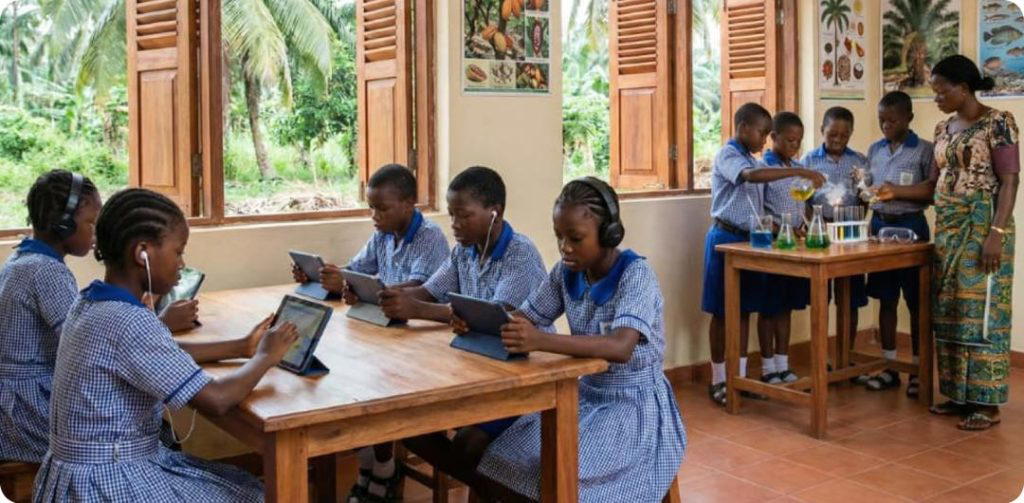
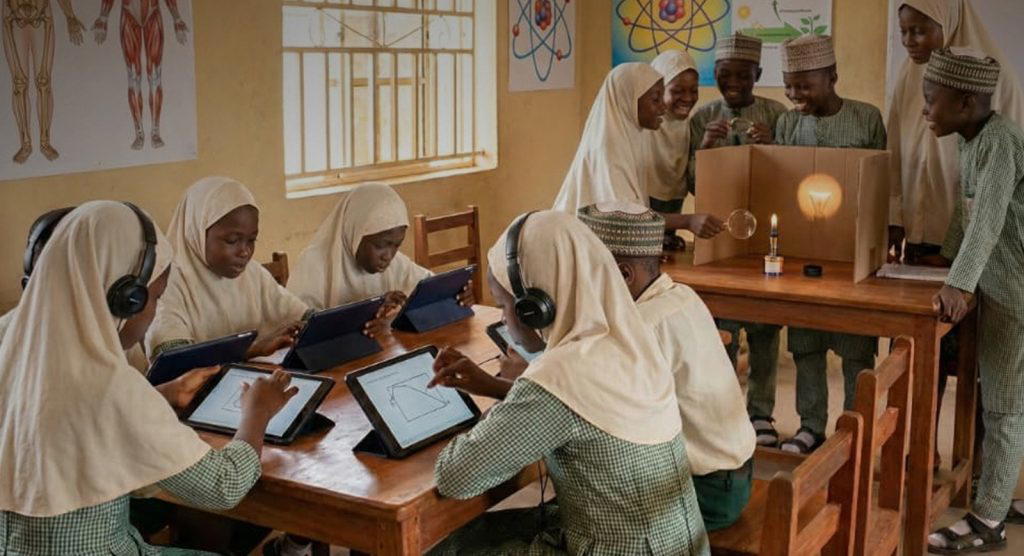
Let me explain what I mean by a micro-school, because this isn’t some abstract concept. It’s already happening informally, and it’s about to scale in ways most people don’t see coming. The infrastructure already exists; rooms in homes, church halls during weekdays, mosque annexes, community centers, etc.
Now, picture this: The kids go to the church hall, the mosque annex, or a spare room in someone’s compound, spaces that already exist in the neighborhood. Instead of a 30-minute commute across town, they walk five minutes. There’s a supervisor everyone trusts, maybe Mrs. Abdulfatai, who’s good with kids and knows the community. The families pool their resources and pay her a reasonable fee.
Then the technical services come in. A platform like uLesson provides the curriculum, the lesson plans, the assessments, the tracking. The science kits arrive when you need them: titration equipment for chemistry, pendulums for physics experiments on oscillating motion, pH meters for testing acids and bases. When it’s time to learn coding, the kids get software tutorials on building apps. When they need to understand AI, the tools and exercises come ready to use.
This is not homeschooling where parents are struggling alone. This is not a traditional school with all its overhead. This is something in between, something new, something that actually works.
Now let’s talk about the economics, because this is where it gets interesting.
The typical urban Nigerian family today pays between 580,000 and 1.4 million naira per child per year for private school. That includes tuition, uniforms, PTA fees, and all the hidden costs. But the biggest cost isn’t even on the invoice. It’s transport. It’s the 30-minute commute each way. It’s the time cost to parents coordinating pickups and drop-offs. It’s the risk and the stress.
Then there’s the real estate. Big central schools need massive plots of land. They need security guards, cleaners, maintenance staff. They need transport fleets that sit idle half the day. All of these costs get baked into your fees.
Micro-schools eliminate most of this. The kids walk to school. The space already exists in the community. The fixed costs you’re already paying for your home now serve double duty. Security is built in because everyone knows everyone. Cleaning is minimal because the space is small.
When you strip away transport, real estate overhead, and all the secondary costs of centralization, you can cut the total cost to families by 40 to 70 percent. We’re talking about 180,000 to 350,000 naira per child per year instead of 580,000 to 1.4 million.
For a family with three children, that’s 750,000 to 3 million naira saved annually. That’s rent. That’s food. That’s healthcare. That’s capital to start a business. Education stops being a poverty trap and becomes accessible.
But here’s what also really matters, and I bet that’s your next question: the quality of education. Can it actually be better?
In a traditional classroom with 40 or 50 kids, differentiated instruction is a theory we talk about in teacher training. In practice, it rarely happens. The teacher can’t possibly conduct proper learning analysis on each child, can’t curate individualized learning plans, can’t adjust in real time to where each student actually is.
In a micro-school with 10 to 15 kids, this becomes real. The supervisor knows exactly where each child is struggling. The platform tracks progress and flags gaps immediately. Learning plans get adjusted weekly based on actual data, not assumptions. Differentiated instruction stops being an ideal and becomes the operating model.
And the learning itself changes. Kids aren’t just memorizing definitions and theories. They’re doing titration experiments in the kitchen with citric acid and baking soda. They’re building pendulums to see oscillation in action. They’re coding actual apps, not just reading about programming. They’re using AI tools to solve problems.
They live the definitions. They situationalize the concepts. The science isn’t something in a textbook. It’s the world around them, and they’re touching it, testing it, building with it.
This is what brings back the joy of learning. Right now, too many kids are bored or lost in overcrowded classrooms. They’ve learned to hate school because school has become about endurance, not curiosity. Micro-schools flip this. Kids want to show up because learning feels like discovery again, not drudgery.
And before anyone worries about social skills, let me be clear: micro-schools don’t isolate children. They’re still learning with peers from the neighborhood. They’re still developing social skills, collaborating on projects, navigating friendships and conflicts. They can still go on field trips, which become advanced outdoor learning experiences where they explore museums, science centers, markets, and natural environments together. The difference is that the social environment is healthier because it’s smaller, more supervised, and rooted in community. These kids aren’t anonymous faces in a crowd. They’re known, seen, supported.
For the 18.3 million children currently out of school, micro-schools offer something traditional schools never could: speed and accessibility. You don’t need to wait for government to build a new campus. You don’t need years of planning and construction. A micro-school can open in weeks. Ten families, one trusted supervisor, one platform provider, and you’re operational.
Suddenly, education becomes available to kids in places that will never get a traditional school. Rural areas. Urban slums. Displaced communities. Anywhere there are families willing to cooperate and a space to gather.
This is the future, and it’s not coming because someone decided it should. It’s coming because the economics make sense, the technology exists, and the need is overwhelming.
The leading school networks in Nigeria didn’t start as big institutions. Many of them started as homeschool cooperatives, mothers who came together to educate their own children and discovered other parents wanted in. One of the most recognized names in Nigerian education, started as a group of expatriate women in Ikoyi who rented a space to teach their own kids.
Micro-schools are the same model, but now the technology exists to standardize quality across thousands of locations. The platform provides the curriculum, the training, the content, the data. Local operators provide the space, the supervision, the community trust. This is education franchising. This is the McDonald’s model, not the charity model.
The private sector will lead this because the incentives align. Parents are already paying. They’re voting with their wallets. Operators can start small, iterate fast, close bad locations, expand good ones. Government doesn’t need to build. Government needs to enable: light regulation, outcome standards, vouchers for the poorest families so the state pays for seats without building schools.
Now, to scale micro-schools across Nigeria, we need to solve a critical regulatory challenge:
The Ministry of Education licenses “sites,” not “systems.” You can’t apply for 5,000 individual school licenses without the bureaucracy grinding everything to a halt.
The solution lies in a Hub-and-Spoke certification model. Here’s how it works: establish a few fully accredited “Anchor Schools” that hold Master Licenses and are recognized centers for WAEC, NECO, and JAMB. The micro-schools then register as Satellite Learning Centers under these Anchor Hubs. Students attend their neighborhood micro-school daily, but on paper, they’re students of the Hub.
The uLesson platform handles the technical side: continuous assessment scores and attendance automatically upload from micro-schools to the Hub’s database, satisfying government requirements without physical inspections of every location. Each student gets a Universal Learner ID that follows them regardless of which micro-school they attend. For major national exams, students travel to the Hub or a designated center for that week only.
Quality assurance happens digitally. The Hub monitors supervisor performance through platform analytics, conducts live lessons beaming master teachers into multiple micro-schools simultaneously, and performs video spot-checks. When regulators ask about libraries or labs, you point to the digital resources on tablets and the physical Resource Hub where students go monthly for hands-on learning.
This creates a regulatory safe harbor. Progressive states like Lagos or Edo could pilot a Micro-School License that waives traditional real estate requirements in exchange for verified learning outcomes, safety standards, and supervisor background checks. The model provides accountability without the impossible burden of licensing thousands of individual locations.
This isn’t idealism. This is pattern recognition.
Nigeria has already shown us how to tackle impossible infrastructure problems. We didn’t wait for the national grid to work. We didn’t wait for bank branches to reach every village. We didn’t wait for hospitals to serve everyone.
We innovated. We decentralized. We let communities solve their own problems with the tools available.
Moniepoint brought banking to every neighborhood. Solar brought power to millions of homes. Pharmacies and clinics brought healthcare within walking distance.
Education is next!
The post A Vision for Nigerian Basic Education appeared first on Vanguard News.